
The countertop materials that make small kitchens look bigger share three traits: light tones, low-contrast veining, and a finish that reflects rather than absorbs the room’s light. Granite, quartzite, and engineered quartz all qualify, but they perform differently in a compact, high-use kitchen. Beyond material selection, the fabrication decisions (edge profile, surface finish, seam placement) control how the final installation actually reads in the space.
Alpha Granite has been fabricating and installing custom stone surfaces across Central Texas since 2003, and as an Accredited Natural Stone Company, the guidance here is grounded in fabrication reality, not design opinion. This guide breaks down both layers so you can make an informed decision before you select a slab.
Why Countertops Have More Control Over Your Kitchen’s Size Than You Think
Small kitchen countertop choices are usually treated as a style decision. Pick a color, pick a material, move on. But the countertop is one of the largest continuous surfaces in the room. That makes it one of the strongest spatial signals you have.
Most buyers focus on the surface they want to see. Few ask how that surface will behave under the room’s light, or how much visual noise the veining will create once it’s installed at full scale. A surface with heavy veining and a matte finish in a compact kitchen creates exactly that problem: the eye has nowhere to rest, and the room reads busier and smaller than it is.
A surface with consistent tone and a polished finish does the opposite. It reflects light, extends sightlines, and makes the square footage read as more generous than it actually is. That’s not a design preference. It’s how surfaces behave under real kitchen conditions. And it starts with understanding which materials and fabrication details give you that control.
The Materials That Actually Perform in a Compact Space
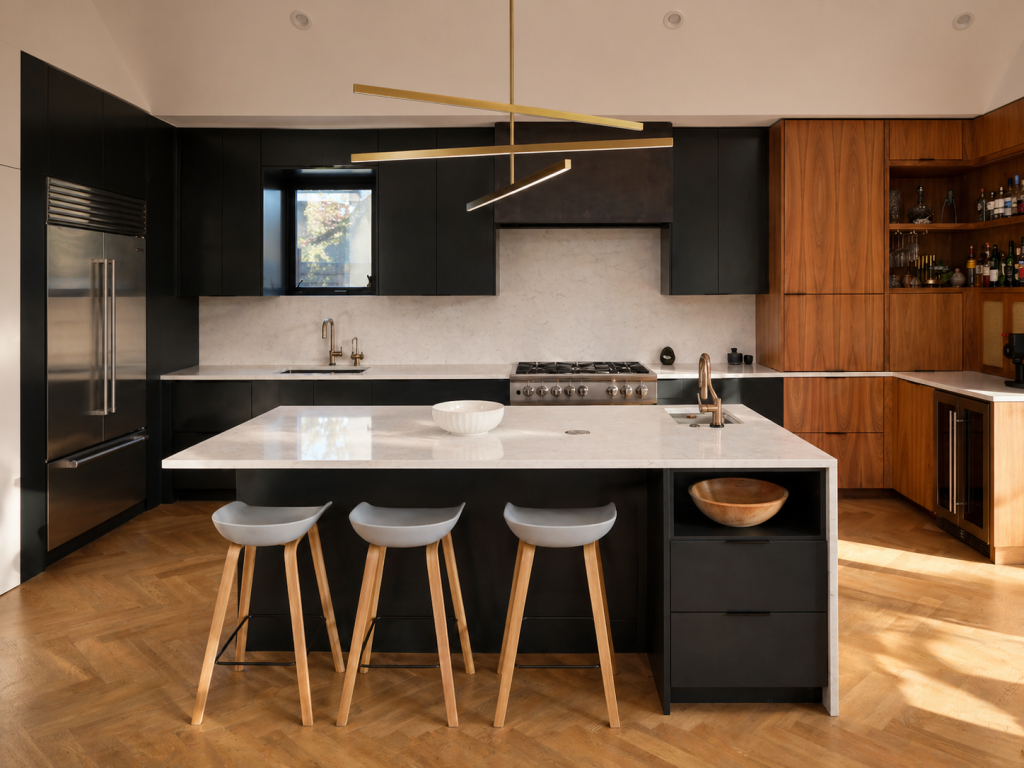
In a small kitchen, the countertop materials that create the strongest sense of space are those with light tones, polished or honed finishes, and low-contrast veining. Granite, quartzite, and quartz each qualify, but they perform differently.
Granite in lighter tones (whites, creams, soft grays) works well in compact kitchens because the natural variation stays subtle enough to reflect light without creating visual clutter. A polished granite finish amplifies that effect. Granite is porous, so it requires periodic sealing to hold up in a high-use kitchen. In a compact space that sees daily cooking, resealing every one to two years is realistic. Skip it, and you’ll start to see staining near the sink and cooktop.
Quartzite brings similar spatial benefits with stronger long-term durability. It’s harder than most granites, handles daily use well, and the veining in lighter quartzite slabs tends to be linear and low-noise, exactly what a small kitchen countertop needs. If you’re comparing materials in person, quartzite surface performance holds up across demanding conditions.
One important note: quartzite is sometimes mislabeled at the slab level. A slab sold as quartzite that’s actually dolomitic marble will etch and scratch under real kitchen conditions. Working with a fabricator who can verify the material before fabrication begins matters more than most buyers realize.
Engineered quartz is the most consistent option visually: no variation, no surprise veining, no sealing required. That consistency helps in a compact space because the surface reads as uninterrupted. The tradeoff is heat sensitivity: quartz resins begin to break down at high temperatures, making it less tolerant of hot cookware than natural stone. For a small kitchen where the cooktop sits close to the counter, that’s a real use consideration. For more on keeping it performing long-term, quartz countertop maintenance is worth reviewing before you decide.
If you’re in Central Texas and want to see how these materials actually read under light before selecting, Alpha Granite’s Austin showroom carries a surplus of stone samples across all three categories. The difference between a slab photo and the real surface is significant in a compact kitchen.
The Fabrication Decisions That Control How Big Your Kitchen Feels
Most buyers spend their decision time on material. Few ask about edge profiles, finish types, or seam placement. Those second and third decisions control the final result as much as the material choice, and they’re the ones most fabricators won’t walk you through unless you ask.
Edge profile. A chunky or ornate edge (ogee, dupont, full bullnose) adds visual weight to the countertop boundary. The eye lands on it and stops. A slim eased or beveled edge keeps the eye moving across the surface and into the room. In a compact kitchen, that difference is visible in the finished installation. It’s also a decision most buyers never think to ask about until they’re looking at a granite vs. marble comparison and wondering why two similar materials read differently in photos.
Surface finish. Polished finishes reflect light directly, which serves spatial openness. Honed finishes absorb more light and produce a matte effect that can close in a small kitchen, especially if the material runs mid-to-dark in tone. Match the finish to the material’s base tone and the room’s natural light conditions, not just to a texture preference.
Seam placement. In a small kitchen, seams are hard to hide. Poor placement creates visible breaks that fragment the countertop into smaller-feeling sections. Precise digital templating minimizes seam visibility and keeps the surface reading as one continuous plane. This is one area where fabrication quality shows up immediately in the finished result.
Countertop-to-backsplash continuity. Running the same stone material up the backsplash eliminates the visual break between counter and wall. The kitchen reads as taller and more open because the eye has no horizontal break to land on. It requires fabrication precision to execute correctly, but when it’s done right, the spatial effect is one of the strongest moves available in a compact kitchen.
Frequently Asked Questions About Countertops in Small Kitchens
What countertops make a small kitchen look bigger?
Countertops with light base tones, low-contrast veining, and a polished finish do the most work spatially. The polished surface reflects light across the room, and consistent patterning keeps the eye moving rather than stopping on visual noise. Granite, quartzite, and engineered quartz all fit that profile when you select the right slab and finish.
Do light-colored countertops actually make a kitchen look bigger?
Yes, but color alone isn’t the full answer. A light-toned slab with heavy veining and a matte finish can still create visual clutter in a compact space. Finish and pattern density matter as much as the base color. Light tone plus polished finish plus low-contrast veining is the combination that consistently opens up a small kitchen.
What is the best countertop material for a small kitchen?
There’s no single winner. The right material depends on how the kitchen is used and which fabrication specs you commit to. Quartzite offers strong durability with natural variation that stays low-noise in lighter slabs. Engineered quartz offers the most visual consistency with no sealing required. Light-colored granite lands between the two on maintenance and performance. In a fabrication consultation, slab layout and kitchen footprint both factor into which material will read best in your specific space. For more common material questions, the Alpha Granite FAQ is a good reference.
Does quartz make a small kitchen look bigger?
It can. Engineered quartz’s consistent, non-porous surface reads as uninterrupted, which helps spatially. The caveat is heat sensitivity. Quartz is less tolerant of hot cookware than natural stone, which is worth factoring in if your cooktop sits close to the counter. For a high-use compact kitchen, that’s a real use condition to weigh against the low-maintenance advantages.
See the Difference the Right Stone Makes in Person
The material and fabrication decisions covered here are easier to evaluate in person than on a screen. Finish, tone, and veining all read differently under real light. In a compact kitchen, those differences matter.
Alpha Granite’s Austin and Kerrville showrooms carry a surplus of stone samples across granite, quartzite, and engineered quartz. You can see how finishes behave under light, compare veining intensity side by side, and talk through edge profiles and seam placement with the team before anything gets cut.
When you’re ready to move forward, visit the showroom or request a quote at alphagraniteaustin.com.
Austin showroom: (512) 834-8746. Kerrville showroom: (830) 896-8746.