
If heat resistance is on your countertop checklist, you need to pause for a second. In a commercial kitchen, the real issue is not whether a countertop can handle one hot pan. It is whether it can take that heat again and again, in the middle of service, without cracking, staining, or slowly breaking down.
This is about repetition, speed, and pressure. The materials that hold up tend to do so quietly. The ones that fail usually do the same.
What Heat Resistance Really Means in a Commercial Kitchen
When materials are labeled “heat-resistant,” that label often comes from controlled tests. A commercial kitchen is not controlled. Heat shows up fast, unevenly, and at the worst possible moment. Understanding what heat resistance actually means requires looking past surface claims and focusing on how materials behave under daily service conditions.
Why Temperature Change Causes More Damage Than Heat Alone
Most countertop failures are not caused by extreme heat alone. They are caused by thermal shock. That is a rapid temperature change.
Imagine a stainless prep table or stone countertop that has been cool all morning. In the middle of service, a hot pan comes off the line and lands directly on that surface.
The temperature change happens in seconds. Some materials can handle high temperatures, but a sudden change in temperature can cause real issues in the long run.
This is why a countertop can pass high-temperature testing and still crack or weaken over time. Industry groups like Natural Stone Institute and International Surface Fabricators Association often frame heat performance around durability under real use, not just peak numbers.
Direct Contact vs. Ambient Heat Exposure
There is a big difference between heat in the room and heat on the surface.
Ambient heat comes from ovens, ranges, and equipment running all day. Many countertop materials tolerate that just fine. Direct heat is different. We’re talking about hot pots and pans placed directly on the surface, often without warning.
Some materials that hold up near equipment can still fail when a pan is placed directly on them. Operators often assume “resistant” means they can treat the surface as indestructible. In practice, direct contact is where most damage starts.
Why Seam Locations and Fabrication Choices Matter
Heat resistance is not only about the slab material itself. Seams, resins, and adhesives are usually the first points to show stress. Even when the slab handles heat well, seams can expand differently, resins can discolor, and adhesives can weaken under repeated heat and pressure.
These issues rarely fail all at once. They show up slowly as hairline cracks, slight separation, or surface changes that are easy to miss until they are not.
Fabrication standards matter here. In commercial kitchens, quiet failures are often the most expensive because they appear after the install has already proven itself in other ways.
Which Countertop Materials Actually Perform Under Commercial Heat
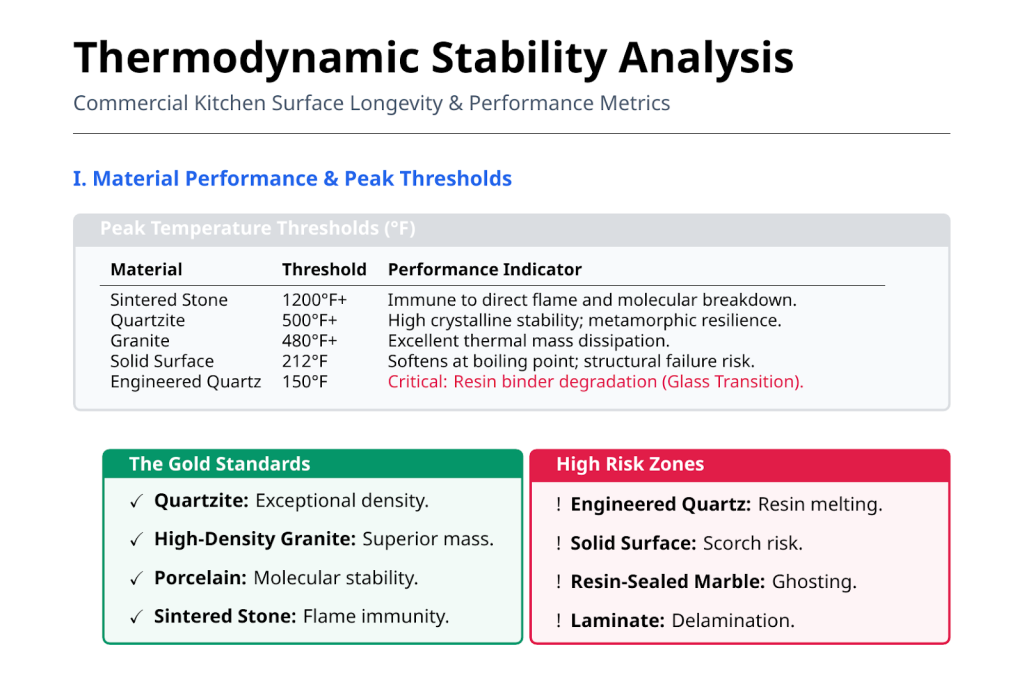
In commercial kitchens, performance shows up over time, not at install. Materials either hold steady under repeated heat cycles or they start to fail quietly. This section breaks down what actually holds up, and why.
Natural Stone. Granite and Quartzite as Proven Heat Performers
According to the NSI, granite countertops continue to be a reliable choice in commercial kitchens because they manage heat through mass, not coatings or binders.
Why natural stone performs well under heat:
- Formed under extreme heat and pressure
- Absorbs and disperses heat throughout the slab
- Handles pans placed directly on the surface without surface breakdown
- Does not rely on resin or surface layers to manage temperature
About sealing and maintenance:
- Sealing protects against stains and liquid absorption, not heat
- Most commercial installations reseal every couple of years
- The process is quick and routine, not a constant upkeep burden
- Proper sealing keeps natural stone countertops clean and long-lasting without affecting heat resistance
Think of sealing like a protective refresh you do every few years to keep the surface performing the way it should.
Porcelain Countertops and Ultra-Compact Surfaces
Porcelain countertops perform well in environments where extreme heat and rapid temperature changes are part of daily operation.
Why does porcelain hold up under commercial heat?:
- Ultra-compact, non-porous structure
- Highly resistant to thermal shock
- Tolerates hot pots and pans placed directly on the surface
- Does not absorb liquid, grease, or heat
Where porcelain excels:
- High-output commercial kitchens
- Outdoor commercial kitchens with sun exposure and rapid cooling
- Environments where sanitation and low maintenance matter
What to watch during fabrication:
- Dense material requires precise cutting and handling
- Support and seam placement must be engineered correctly
- Fabrication quality directly impacts long-term durability
When fabricated properly, porcelain delivers heat resistance with minimal ongoing maintenance.
Quartz and Solid Surface Materials. Where Commercial Heat Becomes a Risk
This is where commercial kitchens often run into trouble. Quartz and heat resistance do not belong in the same conversation for professional use.
Why do quartz kitchen countertops struggle under commercial heat?:
- Made from crushed quartz bound with resin
- Resin does not tolerate repeated high heat
- Direct contact with hot pans can cause discoloration or surface damage
- Failures often appear gradually, not immediately
Solid surface materials face similar limits:
- Designed for consistency, not high heat exposure
- Vulnerable to warping, seam failure, and surface breakdown
- Limited margin for error in busy kitchens
The real risk:
- Damage shows up months or years later
- Repairs are disruptive and costly
- Heat-related failures often occur during peak service periods
With commercial kitchen countertops, materials that manage heat through mass and structure consistently outperform those that rely solely on resin or surface integrity.
Choosing the Right Heat-Resistant Countertop Is a Risky Decision
In a commercial kitchen, countertop material selection affects workflow, maintenance, and downtime long after installation. This is not about colors or surface appeal. It is about how the countertop performs when service is moving fast, and the heat is constant.
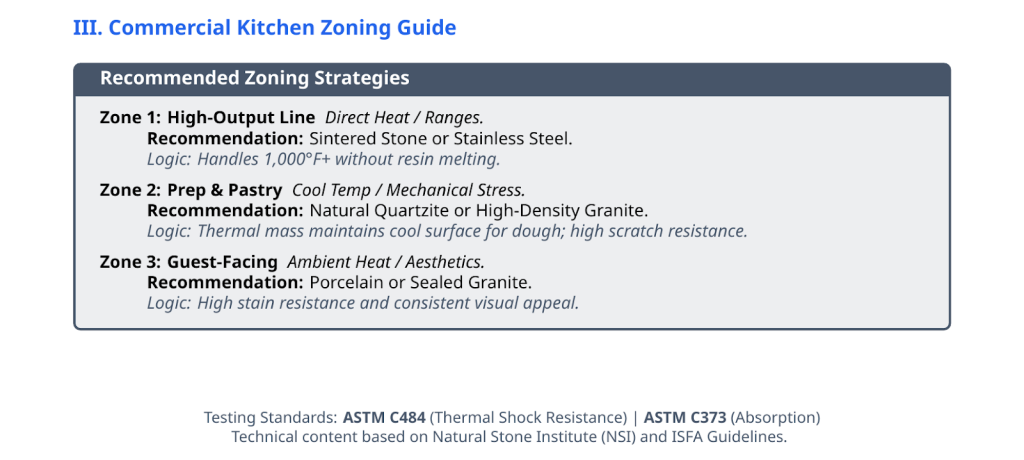
The right conversation starts with how your kitchen actually operates. Equipment placement. Heat zones. Frequency of direct contact. Those details matter more than any surface claim.
If you want to make a decision based on long-term performance, not short-term assumptions, it helps to look at materials in person and talk through real use conditions.
FAQs: Heat-Resistant Countertops for Commercial Kitchens
Can you place hot pans directly on granite or porcelain countertops?
It is not recommended, even with granite or porcelain. While these materials are highly resistant to heat, placing hot pots and pans directly on the surface introduces unnecessary risk in a busy kitchen. Repeated direct contact concentrates heat in one spot and increases the chance of thermal shock, surface stress, or long-term damage near seams.
Why do some countertops crack even if they are rated for high heat?
Most failures come from thermal shock, not peak temperature. When a cool kitchen countertop is suddenly exposed to high heat, stress concentrates in one area, and over time, this can lead to cracks, especially near seams or weak points. Materials that do not distribute heat evenly struggle to withstand rapid temperature changes in busy commercial kitchens.
Is quartz a safe choice for commercial kitchens with heavy cooking?
Quartz countertops are not a safe choice for commercial kitchens exposed to frequent high heat. Quartz contains resin, which does not tolerate repeated heat and pressure. Placing hot pans directly on quartz can cause discoloration or surface damage. In professional settings, quartz is often mistaken as heat resistant as granite, but it does not perform the same under commercial workloads.
Do heat-resistant countertops also resist stains and scratches?
Not always. Heat resistance and stain resistance are separate performance traits. Granite and porcelain are both resistant to scratches and easy to clean, but natural stone needs to be sealed to resist staining. Sealing prevents liquid from seeping into the material and does not affect heat resistance. Scratching, denting, and staining depend on how the countertop is used and maintained.
How does outdoor heat affect commercial countertop performance?
Outdoor commercial kitchens introduce sun exposure, temperature swings, and moisture. Materials need to withstand heat during the day and rapid cooling at night. Porcelain performs especially well outdoors because it is non-porous and highly resistant to thermal shock. Granite also performs well when sealed properly, making it a popular choice for outdoor kitchen installations.
Does sealing affect heat resistance or only stain resistance?
Sealing affects stain resistance, not heat resistance. Granite countertops need to be sealed to prevent liquids, grease, and spills from seeping into the material. The stone’s ability to handle high heat comes from its structure, not the sealer. Think of sealing as routine upkeep that supports durability and low maintenance, not heat performance.
What countertop materials require the least maintenance in busy kitchens?
Porcelain countertops require the least maintenance in most commercial kitchen designs. They are non-porous, easy to sanitize, resistant to stains, and do not need sealing. Granite requires periodic sealing but remains a durable countertop that holds up well under heat and daily use.
Materials like quartz, laminate countertops, and solid surface countertops tend to need more care and introduce more risk under high heat conditions.