
For years, the decision for kitchen countertops was usually a toss-up between granite and quartz. That was the standard. But recently, we have seen a shift in modern kitchen design here in Central Texas. Porcelain countertops are rapidly moving from a specific European design trend to a staple in American homes.
Why are they gaining popularity now? It comes down to a desire for surfaces that can handle the reality of daily cooking. Homeowners are looking for something that handles heat, spills, and UV rays without the limitations of traditional materials.
It is important to clarify that we aren’t talking about the ceramic tiles you might see in a bathroom. We are talking about massive, large-format porcelain slabs engineered to outperform almost everything else on the market.
How Are Porcelain Kitchen Countertops Actually Created?

Starting with Refined Naturals
There is a misconception that porcelain is synthetic or plastic-like, but that isn’t the case. Porcelain countertops are made from a specific blend of natural materials, primarily kaolin clay, silica, and feldspar.
These are actually the same raw minerals you find in granite. The difference is in the control we have over them. Granite comes out of the ground with random imperfections and soft spots.
In contrast, these countertops are made from refined minerals. We remove the impurities and weak points before the manufacturing process even begins.
The Sintering Process
Once we have that pure mineral mix, we put it through a process called sintering. First, the raw material is compressed under thousands of tons of pressure to squeeze out air pockets. Then, the slabs are fired at extremely high temperatures, usually exceeding 2,200°F.
This is significantly hotter than a standard kitchen environment. We aren’t just drying the clay; we are fusing the minerals together on a molecular level.
The Result: Density by Design
This combination of extreme pressure and heat creates a completely non-porous surface that is actually denser than most natural stone. Because the material has already survived temperatures far higher than your stove can produce, it doesn’t react to hot pans.
The result is high-quality porcelain that is incredibly hard and low-maintenance. It isn’t durable by accident; it is durable because it was engineered to be harder than the environment it lives in.
5 Reasons Homeowners Are Switching to Porcelain
1. Superior Heat Resistance
Because the material is fired at extremely high temperatures during manufacturing, porcelain can withstand thermal stress far better than engineered quartz. Quartz contains resin, which can scorch or discolor if a hot skillet touches it. Porcelain doesn’t have that problem.
However, just because it can handle the heat doesn’t mean you should test it daily. We always recommend using a trivet for hot pots and pans. While the surface likely won’t burn, thermal shock is a risk for any stone or ceramic material.
Think of this heat resistance as a safety net for accidental placement, rather than permission to treat your countertop like a stovetop.
2. The “Chameleon” Aesthetic (Mimicking Natural Stone)
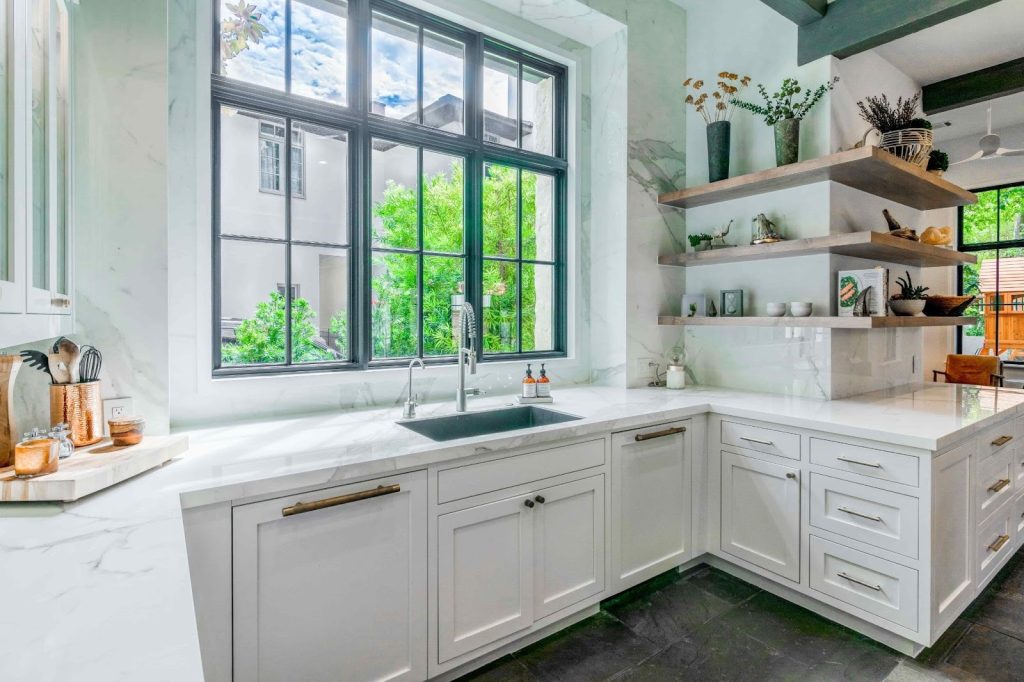
With advancing technology, porcelain can mimic natural stone with incredible accuracy. Using high-definition inkjet printing, manufacturers can replicate the specific veining of Calacatta or Carrara marble without the etching issues that come with the real thing.
It isn’t limited to looking like marble, either. You can find slabs that look like rusted steel, concrete, or wood. This versatility makes it a staple for minimalist kitchens or industrial designs where you want a specific modern look that is visually consistent across the entire room.
3. Zero Absorption, Zero Staining
If you cook with oil, wine, or acidic citrus, this is your biggest advantage. The non-porous nature of this countertop material means it simply doesn’t absorb liquids. Spills sit on the surface until you wipe them away.
You don’t need special sealers or heavy chemicals. Warm water and mild soap are usually all you need to maintain it. This makes it an ideal sanitary surface for a busy kitchen and bathroom, offering a level of stain protection that granite or marble requires constant sealing to match.
4. True Indoor-Outdoor Versatility
This is where porcelain for your kitchen delivers something unique. Unlike quartz, which can yellow or fade under direct sunlight, porcelain is UV stable. The color you buy today is the color it will be ten years from now, even in the Texas sun.
This makes it an excellent choice for outdoor kitchens. You can use the exact same slab material for your indoor island and your outdoor patio, creating a seamless indoor and outdoor design flow that connects your living spaces.
5. Extreme Surface Hardness
Porcelain is incredibly hard, actually harder than granite on the Mohs scale. This makes it highly resistant to scratching from keys, knives, or daily wear. It offers incredible durability on the flat surface.
However, we believe in being transparent about the pros and cons. That extreme hardness also makes the material rigid. The edges can be brittle if struck with a heavy pot. This is why fabrication expertise is non-negotiable. You need a fabricator who knows how to cut and profile the edge to minimize that risk and protect your investment.
See the Innovation for Yourself
You can read about heat resistance and detailed veining, but porcelain only makes sense when you feel it. The texture, the finish, and the strength tell a story that words alone cannot. If you are curious about why porcelain is redefining modern kitchen design, seeing it up close is the next step.
Visit us at Alpha Granite in Austin or Kerrville to explore a wide variety of stone samples and porcelain surfaces. You will be able to compare options, understand how each one performs, and see what fits your project.
Frequently Asked Questions About Porcelain Countertops
Is porcelain better than quartz?
“Better” depends entirely on where you are putting it. Porcelain and quartz are both high-performance engineered materials, but they have different strengths. Porcelain allows for outdoor use (it’s UV stable) and handles heat better than quartz. However, quartz has one specific aesthetic advantage: the patterns usually run all the way through the slab (full-body). In contrast, the pattern on most porcelain is printed on the surface, meaning the edge profile will often be a solid color rather than continuing the vein.
Can I really cut directly on porcelain?
Technically, yes. Porcelain surfaces are incredibly hard and scratch-resistant enough to handle knife blades without showing a mark. However, we always recommend using a cutting board. Why? Because the material is actually harder than the metal in your cutlery. While you won’t hurt the countertop, you will dull your expensive chef’s knives very quickly.
Does porcelain look like real marble?
Yes. Modern porcelain technology has evolved to the point where high-definition printing can mimic natural marble veining so accurately that it is often difficult to tell the difference visually. It gives you the high-end luxury look with minimal maintenance, saving you from the etching and staining fears that come with real marble.
Is porcelain expensive?
Porcelain countertops generally fall into a mid-to-high price range, comparable to premium granite or quartz. It is important to understand that the cost often comes from the specialized fabrication required. Because the slabs are so dense and hard, cutting and polishing them requires specialized tooling and takes more time than softer stones, which influences the final installed price.
Can porcelain be used for backsplashes?
Absolutely. In fact, it is one of the best materials for it. Because porcelain slabs are often manufactured in thinner profiles (like 6mm or 12mm) that are lighter than stone, they are perfect for full-height backsplashes and wall cladding. This allows you to create a sleek, grout-free vertical surface that defines a modern kitchen.